
|

|
|
||||
| ► Browse Magazine Back Issues |
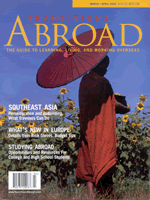
Transitions Abroad Magazine Mar/Apr 2005 Vol. XXVIII, NO. 5 |
||
 |
 |
|
|
Information Exchange Traveler’s Almanac Abroad at Home Interview Immersion Travel Back Door Travel Study Abroad Study Abroad and Teen Travel Working Traveler International Careers Living Abroad Program News & Notes Book Reviews Marketplace Classifieds Transitions Abroad |
From the Editor When the Indian Ocean tsunami hit we had just gone to press with the January/February issue of Transitions Abroad, which highlights Asia and the Pacific Rim. Reading about the beauty of the region and its people made this tragedy all the more poignant. The world’s response has been a generous outpouring of volunteerism and resources. Now, some months out of the tsunami, aid is even more essential. So is traveling. The tsunami-affected regions are largely dependent on the travel industry for their livelihoods. By spending tourist dollars responsibly in impacted countries, we can help them rebuild — if we follow the empowering and sustainable practices addressed by Tim Leffel (page 88) and Jessica Hayden (page 14): Jan Egeland, the U.N. official coordinating aid for tsunami survivors, praised the world for its likely fulfillment of 100 percent of the U.N.’s tsunami crisis appeal. But he worried that aid to Southeast Asia would detract from other endangered regions routinely receiving only a fraction of the funds required to save lives. One of his examples (quoted from the BBC): “The Democratic Republic of Congo, where 1,000 people die daily of preventable diseases or because of the conflict there, [suffers] the equivalent of a tsunami every five months.” Many of these humanitarian crises are manmade, as is the case in military-ruled Myanmar (Burma). Despite concerns over its repressive government and Aung San Suu Kyi’s wishes for travelers to stay away, we think it is worth sharing Rob Sangster’s mesmerizing and candid "The Road to Mandalay" (page 18), as well as Debbie Jefkin’s cover photo and "The Last Page" image. Both are stirring reminders of Myanmar’s apolitical magnificence. Prospective travelers should continue to monitor events in Myanmar and consider the arguments for and against travel there. There has been a surge in volunteer travel in the wake of the disaster, and we’ve received many queries on how people can roll up their sleeves and help in tsunami-impacted regions. Some organizations like United Volunteers have a waiting list of several hundred due to an overwhelming response. A sampling of how our advertisers are helping in tsunami relief efforts is on page 15. On our website, www.TransitionsAbroad.com, we have maintained invaluable resources and information since December 26. Despite global tragedies, natural and manmade, students continue to explore far and wide. More than just studying abroad, they are making the most of their overseas opportunities with immersion activities like living with host families, working, and volunteering. Their experiences, as well as 2005 Transitions Abroad Student Writing Contest winner Emily Hilk's article on studying at Oxford University, start on page 37. We’ve also moved the teen travel resources section to this issue and included high school students' perspectives on international exchanges. Finally, we would like to thank Sri Lankan and multiple-time Transitions Abroad contributor Preethi Burkholder and her husband Trent, as well as Transitions Abroad columnist Tim Leffel. At their request, we doubled their payments, which will go to the tsunami relief effort. Next issue’s, special focus will be on language schools and language-learning vacations. — Sherry Schwarz
|
|
|
|
| About Us | |
| Contact Us | |
'%3e%3cg id='Final-Copy-2_2_' transform='translate(1275.000000, 200.000000)'%3e%3cpath class='st0' d='M7.4,12.8h6.8l3.1-11.6H7.4C4.2,1.2,1.6,3.8,1.6,7S4.2,12.8,7.4,12.8z'/%3e%3c/g%3e%3c/g%3e%3c/g%3e%3cg id='final---dec.11-2020'%3e%3cg id='_x30_208-our-toggle' transform='translate(-1275.000000, -200.000000)'%3e%3cg id='Final-Copy-2' transform='translate(1275.000000, 200.000000)'%3e%3cpath class='st1' d='M22.6,0H7.4c-3.9,0-7,3.1-7,7s3.1,7,7,7h15.2c3.9,0,7-3.1,7-7S26.4,0,22.6,0z M1.6,7c0-3.2,2.6-5.8,5.8-5.8 h9.9l-3.1,11.6H7.4C4.2,12.8,1.6,10.2,1.6,7z'/%3e%3cpath id='x' class='st2' d='M24.6,4c0.2,0.2,0.2,0.6,0,0.8l0,0L22.5,7l2.2,2.2c0.2,0.2,0.2,0.6,0,0.8c-0.2,0.2-0.6,0.2-0.8,0 l0,0l-2.2-2.2L19.5,10c-0.2,0.2-0.6,0.2-0.8,0c-0.2-0.2-0.2-0.6,0-0.8l0,0L20.8,7l-2.2-2.2c-0.2-0.2-0.2-0.6,0-0.8 c0.2-0.2,0.6-0.2,0.8,0l0,0l2.2,2.2L23.8,4C24,3.8,24.4,3.8,24.6,4z'/%3e%3cpath id='y' class='st3' d='M12.7,4.1c0.2,0.2,0.3,0.6,0.1,0.8l0,0L8.6,9.8C8.5,9.9,8.4,10,8.3,10c-0.2,0.1-0.5,0.1-0.7-0.1l0,0 L5.4,7.7c-0.2-0.2-0.2-0.6,0-0.8c0.2-0.2,0.6-0.2,0.8,0l0,0L8,8.6l3.8-4.5C12,3.9,12.4,3.9,12.7,4.1z'/%3e%3c/g%3e%3c/g%3e%3c/g%3e%3c/g%3e%3c/svg%3e) Your Privacy Choices
Notice at Collection
Your Privacy Choices
Notice at Collection