Budget Travel in Mexico and Central America
Planning for a Cheap Trip
By Tim Leffel
|
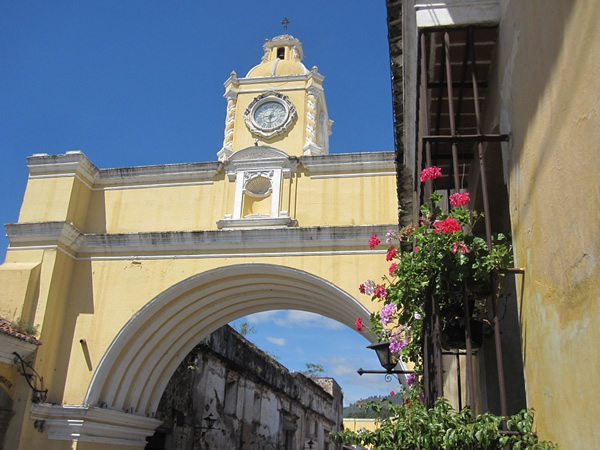
Visit the beautiful town of Antigua, Guatemala. |
Mexico and the countries of Central America attract plenty of budget travelers, and for good reasons. The coastal resort areas of Mexico cater to tourists on a short vacation — and are priced to match — but the rest of the vast country offers plenty of value and a good infrastructure. Costa Rica and Belize have gotten expensive for the same reason as parts of Mexico, but there are plenty of other options for those on a budget. In their own ways, Nicaragua, Honduras, El Salvador, and Guatemala offer some of the world’s best bargains.
Mexico and Central America share a lot of traits and a lot of common heritage. Pre-colonial civilizations such as the Toltecs, Mayans, and Aztecs spread across an area where borders and state governments were fluid. The same Spanish colonial government that was spreading its influence across Mexico was also busy building Antigua (Guatemala) and Granada (Nicaragua). So the divisions we see on a map at times feel more arbitrary than the people scattered across them.
|
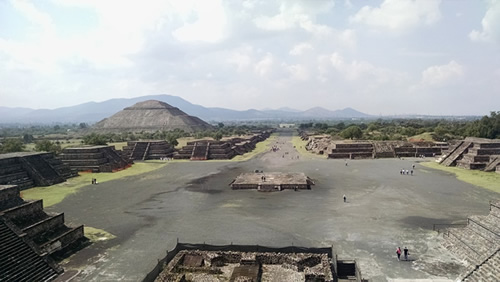
Travel in Mexico to the Teotihuacan temple. |
A little Spanish will suit you throughout. The exceptions are Belize, where English is the common language, and the rural Mayan areas of the region.
In terms of budget planning, it’s best to look at the region in two divisions. First would be the tourist zones: coastal Mexican resort towns (Cancun, Puerto Vallarta, Mazatlan, Cabo San Lucas), all of Costa Rica, and the islands of Belize. Roatan Island, part of Honduras, is also geared more to divers, sun-and-fun vacationers, and cruise ship passengers, but nearby Utila offers a budget alternative. The rest of the country is as cheap as anywhere else in the region. In most other locations, you can get by for $25-$60 a day as a backpacker, with Mexico being at the high end of that range and Nicaragua, Guatemala, and mainland Honduras being at the lowest end. As always, your mileage will vary — much of it depends on your comfort level and how much you are moving around. In Mexico, for instance, the bus system is extensive and efficient, but a few long trips in a row can really jack up the daily average. If you go diving or on guided jungle treks, the budget naturally has to factor in the activities.
Editor's note: Always check crowdsourced sites such as Numbeo.com for
a general idea of costs and see How to Manage Your Money Safely in Latin America for some key information.
For U.S. and Canadian residents, there are several factors that make this region a good choice. Flights are often only $100 to $250 more than a domestic flight and there’s no time change jet lag to deal with. In addition, currencies stay relatively stable and Panama even uses the U.S. dollar. For those coming from the E.U. or Japan, however, it means even better deals. Visa fees and departure taxes range from zero to "not bad" and you can generally stay for three to six months without renewal. Last, there’s much less anti-American or anti-Western sentiment (whether perceived or real), in this part of the world — it seems like half the people you meet have at least one relative living in Los Estados Unidos.
Cheap Accommodations
Budget accommodations are plentiful throughout Mexico and Central America and there’s seldom a whole lot of incentive to bunk down in a dormitory-style hostel unless you get stuck in a really expensive tourist zone. If you do, however, you can sometimes find a place to stay for as little as $15. A private double room with a shared bath can be as little as $20-$30 in some spots, but can start at $25-$50 in tourist beach zones of Mexico, Belize, and Costa Rica. Some are going to be grubby, but many are in evocative old colonial buildings with plenty of charm. Spending another $10 a night is often enough to move up a level and get maid service, a private bath, and a large room in a place with a pretty courtyard or garden. Nearly every place you stay will have free Wi-Fi.
If you’re scuba diving or getting certified, it’s worth looking into package deals in Belize and Honduras. The second-largest barrier reef in off the coast of Central America, yet the diving prices here are among the cheapest in the world. Plus you're almost guaranteed to see plenty each time you go under.
Cheap Food & Drink
|
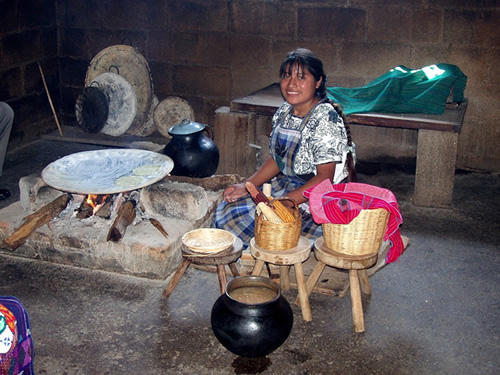
A local woman cooking tortillas in Chiapas, Mexico. |
Mexico and Central America comprise a large area geographically, so it is hard to make many generalizations. When it comes to meals, however, especially lunch, you can find an inexpensive set meal in nearly any town between Playa del Carmen and Panama City. You sit down at a simple restaurant or market stall, figure out what’s on offer, and get a hearty meal for $2 to $8. Throughout the region, expect to eat some combination of corn tortillas, rice, beans, eggs, and meat — especially chicken. On the coasts there will naturally be more coconut, fish, and seafood and the local fruit and vegetables will vary a lot from country to country. What you won't find often is a real salad: you'll have to supplement with your own vegetables or splurge sometimes.
Wherever there has been a lot of tourist influence, the cuisine bar is higher and you can find all kinds of inventive dishes — though expect higher prices to match. Some items that are expensive at home, such as avocados and mangos, are abundant and cheap. In most towns, bakeries offer some substantial breakfast and snack options for cheap and every little village is going to have some street stall stands for bargain snacking. If there's a local market, that's where you'll find the cheapest meals. In a lot of areas there are juice stands, with fresh-squeezed versions of whatever is available in the local markets at that time of year. A lot of coffee is grown here, but unfortunately most of the good stuff gets exported. You have to search around sometimes to find a quality cup of java — or visit a coffee farm.
Rum, tequila, and beer are the alcoholic drinks of choice. Tequila comes from Jalisco in Mexico, rum is especially good in Nicaragua and Guatemala, and the beer ranges from passable to great. There’s not much of a wine industry in this region, though it’s improving in parts of Mexico. Going out for drinks is especially cheap in Nicaragua and Panama, so save your biggest partying bouts for those countries.
Except in progressive cities such as Mexico City, Panama City, and Leon (Nicaragua), and in beach resort areas, bars are mostly a male affair. Machismo rules throughout Latin America, so outside of obvious tourist zones, scope a bar out first and/or go with a male companion. The bigger the city, the more likely you are to find places that cater to couples and mixed groups of friends.
Cheap Transportation
Internal flight prices are not always a great bargain, but are reasonable and more plentiful each year, especially on the former Taca routes of Avianca and small puddle jumper routes. Mexico has four financially solid budget airlines now: Interjet, Volaris, Aeromar, and Viva Aerobus. Several small domestic airlines can save you a lot of time for short distances, like Air Panama in that country, Nature Air in Costa Rica, and TropicAir serving Belize, Tikal, Honduras, and Cancun.
Otherwise, expect to spend lots of time on a bus. Train service is almost non-existent in this region apart for a few set up for tourists and the line along the Panama Canal from the capital to ugly Colon. Buses range from glorious 3-seats-across luxury coaches with Wi-Fi and snacks in Mexico to discarded school buses from the U.S. now turned into bumpy “chicken buses.” The latter will stop a dozen times every five miles it seems, but at least they don’t cost much. You get what you pay for, so opt for a better class when it’s available and the budget will allow. For popular tourist routes, there will often be a minivan shuttle that is direct. If you have a group, it can be just as cheap to charter your own vehicle.
Taxis are inexpensive except where lots of tourists on a short vacation congregate: Costa Rica, Mexican beach resorts, and northern Belize, for instance. You can often hire a car and driver for the day for the same or less than renting a car, but the latter can be good for a group wanting to do an overnight excursion or take time seeing the sites. Expect to pay as much or more as you would for a car in Europe, Canada, or the U.S., however, and you generally can't take it across the border to a different country.
Resources for Mexico and Central America Budget Travel
In terms of guidebooks, they all have
their ups and downs and it’s hard to recommend one
specific series for Mexico and Central America. Also, many
of the guidebook publishers now offer information primarily
on their websites. Lonely
Planet’s
Central America is the obvious choice
if transversing the region.
The Rough
Guides Central America and the Caribbean section offers
excellent background and cultural information. So leaf through these guidebooks and see
which suits you best. For Mexico you're better off getting one
for a specific region than the whole huge country. It's too
much to jam in otherwise. One great exception is The
People's Guide to Mexico,
which will give you more insight into the country and its
people than all the others added together.
Numbeo.com is a crowdsourced database that provides fairly accurate cost comparisons to help you determine your travel budget. It is good to consult the site for the latest costs.
Want to figure out what kinds of shots or meds you might need? Consult a guidebook and go here for more up-to-date info:
|
Tim Leffel is author of several books, including A Better Life for Half the Price: How to prosper on less money in the cheapest places to live. See more on his Cheapest Destinations Blog.
|


'%3e%3cg id='Final-Copy-2_2_' transform='translate(1275.000000, 200.000000)'%3e%3cpath class='st0' d='M7.4,12.8h6.8l3.1-11.6H7.4C4.2,1.2,1.6,3.8,1.6,7S4.2,12.8,7.4,12.8z'/%3e%3c/g%3e%3c/g%3e%3c/g%3e%3cg id='final---dec.11-2020'%3e%3cg id='_x30_208-our-toggle' transform='translate(-1275.000000, -200.000000)'%3e%3cg id='Final-Copy-2' transform='translate(1275.000000, 200.000000)'%3e%3cpath class='st1' d='M22.6,0H7.4c-3.9,0-7,3.1-7,7s3.1,7,7,7h15.2c3.9,0,7-3.1,7-7S26.4,0,22.6,0z M1.6,7c0-3.2,2.6-5.8,5.8-5.8 h9.9l-3.1,11.6H7.4C4.2,12.8,1.6,10.2,1.6,7z'/%3e%3cpath id='x' class='st2' d='M24.6,4c0.2,0.2,0.2,0.6,0,0.8l0,0L22.5,7l2.2,2.2c0.2,0.2,0.2,0.6,0,0.8c-0.2,0.2-0.6,0.2-0.8,0 l0,0l-2.2-2.2L19.5,10c-0.2,0.2-0.6,0.2-0.8,0c-0.2-0.2-0.2-0.6,0-0.8l0,0L20.8,7l-2.2-2.2c-0.2-0.2-0.2-0.6,0-0.8 c0.2-0.2,0.6-0.2,0.8,0l0,0l2.2,2.2L23.8,4C24,3.8,24.4,3.8,24.6,4z'/%3e%3cpath id='y' class='st3' d='M12.7,4.1c0.2,0.2,0.3,0.6,0.1,0.8l0,0L8.6,9.8C8.5,9.9,8.4,10,8.3,10c-0.2,0.1-0.5,0.1-0.7-0.1l0,0 L5.4,7.7c-0.2-0.2-0.2-0.6,0-0.8c0.2-0.2,0.6-0.2,0.8,0l0,0L8,8.6l3.8-4.5C12,3.9,12.4,3.9,12.7,4.1z'/%3e%3c/g%3e%3c/g%3e%3c/g%3e%3c/g%3e%3c/svg%3e) Your Privacy Choices
Notice at Collection
Your Privacy Choices
Notice at Collection